
 CX Genie
Service Desk vs Helpdesk, The Real Difference and a Quick Diagnostic
Learn service desk vs helpdesk with a 10-point diagnostic, comparison table, and 30-day metrics plan to improve support outcomes.
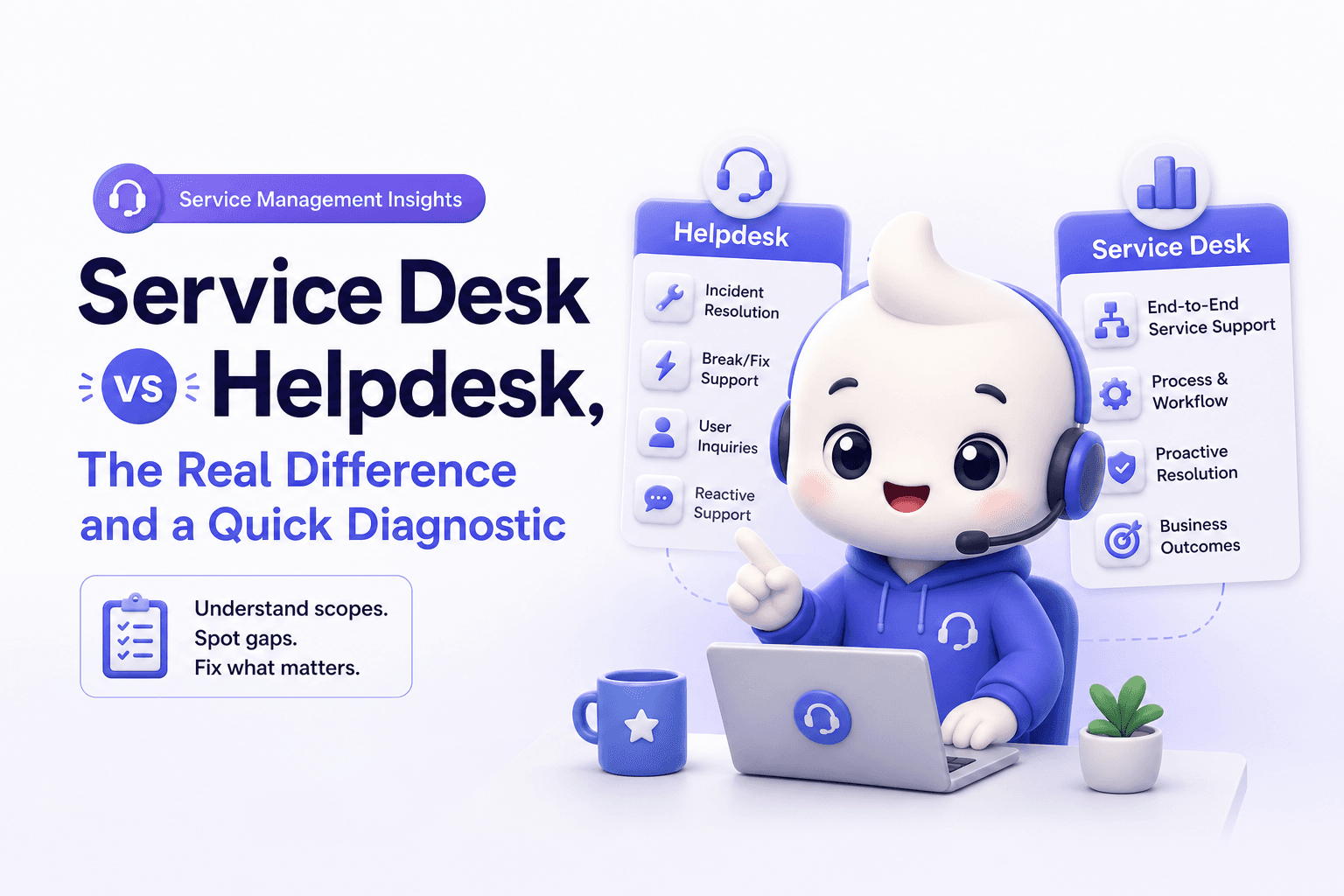
If you are debating service desk vs helpdesk, you are probably feeling the same pain: tickets get closed, but issues keep coming back, ownership is unclear, and reporting does not match what customers experience. The practical difference is less about definitions and more about scope and who owns outcomes.
Key takeaways
Help desk focuses on resolving incidents and requests fast; service desk expands to owning the end-to-end service experience (catalog, SLAs, knowledge, and continual improvement).
Use the 10-point diagnostic below to classify what you actually run today: help desk, hybrid, or service desk, then pick the next two maturity moves.
In the first 30 days, measure first response time, resolution time, CSAT, reopen rate, and self-service rate to prove progress.
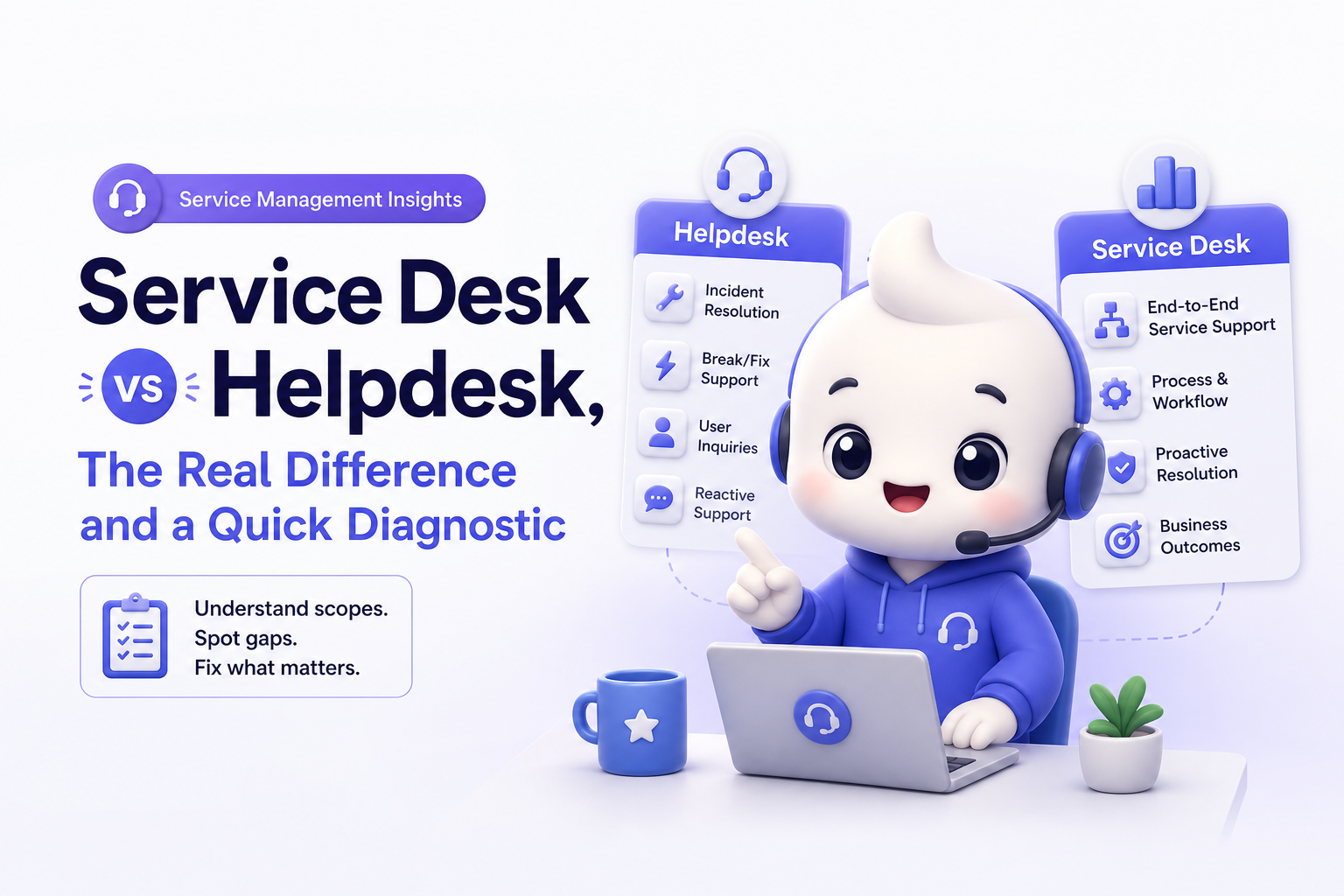
Service Desk vs Helpdesk, The Practical Difference in One Minute
Plain-English definitions you can use internally
Help desk: A team (or function) that handles user issues and questions, typically incidents and service requests, with a goal of restoring normal operation quickly.
Service desk: A broader function that acts as the front door for services, not just issues. It manages requests through a service catalog, owns SLAs and communications, uses knowledge systematically, and feeds recurring problems into improvement.
The practical test: scope and ownership
When people argue about service desk vs helpdesk, the fastest way to settle it is to ask two questions:
Scope: Are you mainly handling “something is broken” and “please do X,” or are you also managing access, onboarding, standard services, and proactive communications?
Ownership: Do you own the experience and outcomes (SLAs, status updates, knowledge quality, trend reduction), or only the act of closing tickets?
Why interchangeable usage causes real operational pain
Many organizations label a team “service desk” while operating a help desk workflow. That mismatch creates predictable consequences:
Stakeholders expect catalog-level consistency, but the team works from ad hoc inboxes and tribal knowledge.
SLAs exist on paper, but no one owns breach prevention or customer updates.
Reporting focuses on volume closed, not repeat drivers or customer effort.
Side-by-Side Comparison of Scope, Processes, and Outcomes
A comparison table you can copy into a deck
Use this to align expectations across IT, operations, and customer support. It is intentionally practical: what you do daily, what you measure, and what “good” looks like.
Area | Help Desk (typical) | Service Desk (typical) | What to implement next (if you are maturing) |
|---|---|---|---|
Primary work | Incidents and basic requests | Incidents, requests, access, standard services, communications | Define top 10 request types and standardize intake |
Intake channels | Email, phone, chat, ad hoc forms | Omnichannel with consistent categorization | Single set of categories across channels |
Service catalog | Often missing or informal | Explicit catalog with request models | Start with a “minimum viable catalog” of 10 items |
SLA ownership | Agent-level or unclear | Queue and service-level ownership with breach management | Set SLA by priority and automate breach alerts |
Knowledge base | Optional, scattered docs | Curated KB linked to ticket categories and deflection | Write 15 articles for your top drivers |
Problem management | Reacts to repeats | Tracks repeat drivers and triggers root-cause work | Weekly “top 5 repeats” review with owners |
Reporting outcomes | Tickets closed, average handle time | Time to restore, CSAT, reopen rate, deflection, trend reduction | Add reopen rate and deflection to your dashboard |
Where ITIL fits (without over-indexing on it)
If you want a standard reference point, the service desk concept is strongly associated with IT Service Management and ITIL. For terminology and practices, see AXELOS ITIL. You do not need to “do ITIL” to benefit from the service desk mindset, but it helps to borrow two ideas: standard request models and continual improvement driven by data.
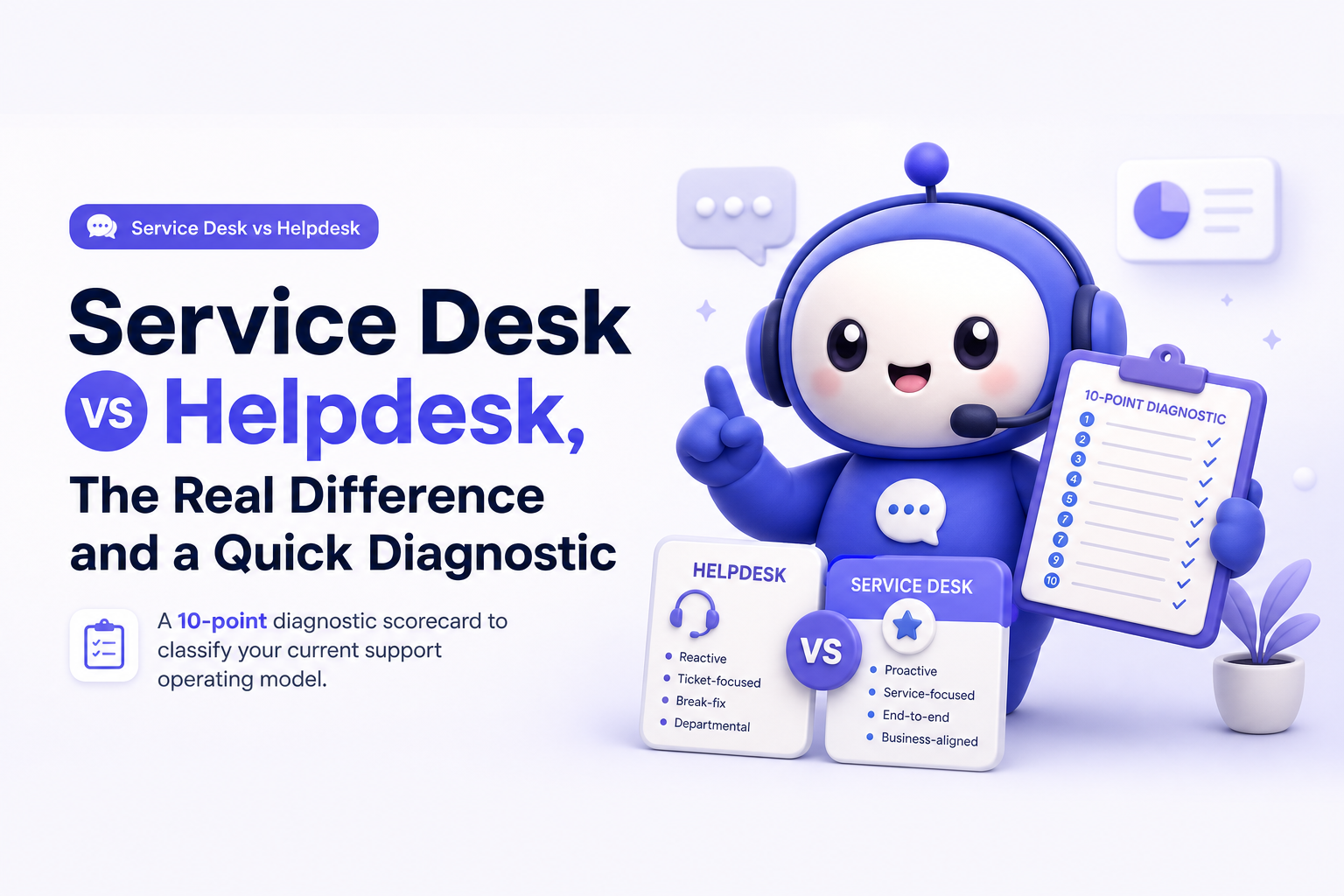
Which One Do You Really Have, A 10-Point Diagnostic Scorecard
How to score it
Score each item 0, 1, or 2:
0 = not in place
1 = partially in place or inconsistent
2 = consistently in place and measured
The 10-point scorecard
Single front door: Users know exactly where to go, regardless of channel.
Consistent categorization: Same categories and priorities across email, chat, phone, portal.
Defined priorities: Priority rules are documented (impact + urgency) and used.
SLA by priority: Response and resolution targets exist for each priority and are tracked.
Status communication: Users receive proactive updates at defined milestones.
Request models: Top requests have standard steps, fields, and approvals.
Knowledge-first workflow: Agents search and link KB articles; gaps are logged.
Escalation rules: Clear triggers for L2/L3 escalation and vendor handoff.
Trend review: Weekly review of repeats, reopens, and top drivers with owners.
Outcome reporting: Dashboard includes CSAT and quality signals, not just volume.
Interpretation thresholds and what to do next
0 to 8 points: Help Desk. Next actions: (1) standardize categories and priorities, (2) publish basic SLAs, (3) create 10 to 15 KB articles for top issues.
9 to 14 points: Hybrid. Next actions: (1) launch a minimum viable service catalog, (2) implement escalation triggers and ownership, (3) run a weekly trend review with a problem backlog.
15 to 20 points: Service Desk. Next actions: (1) improve deflection and customer effort, (2) formalize continual improvement targets, (3) expand catalog coverage and automate request flows.
This diagnostic also keeps the service desk vs helpdesk debate honest: you can call it either, but the score reveals the operating model.
What Changes When You Move Up, Roles, Escalations, and SLAs
The L1, L2, L3 model with clear responsibility boundaries
Most teams struggle not because they lack tools, but because they lack crisp boundaries. Use this as a baseline:
L1 (frontline): triage, categorize, set priority, handle known fixes, fulfill standard requests, communicate updates, and link knowledge.
L2 (specialists): deeper troubleshooting, configuration changes, complex requests, and creating new knowledge from resolved work.
L3 (engineering or vendors): code-level fixes, infrastructure changes, bug resolution, and root-cause work that reduces future volume.
Escalation triggers you can implement tomorrow
Define escalation using objective triggers, not gut feel:
Time-based: 50% of SLA elapsed without progress update, or 75% without workaround.
Complexity-based: requires logs, database access, code change, or admin privileges beyond L1.
Risk-based: security, compliance, payment issues, or high-impact outages.
Repeat-based: same customer reopened twice, or same category spikes above baseline.
A simple RACI for SLA ownership
One of the biggest differences in service desk vs helpdesk is who “owns” the clock and the customer updates. Here is a lightweight RACI you can adopt:
Responsible: L1 queue owner (ensures tickets move, updates sent, SLA monitored)
Accountable: Service owner or support lead (sets SLA targets, approves exceptions)
Consulted: L2/L3 specialists (provide estimates, technical direction)
Informed: Customer or end user (receives milestone updates and resolution notes)
Is a Service Desk Just a Call Center, SPOC in an Omnichannel World
Myth: “Service desk” equals phones and scripts
A call center is typically optimized for throughput and handle time. A service desk is optimized for service outcomes: correct routing, consistent fulfillment, fewer repeats, and better customer effort. You can run a modern service desk primarily through chat and a portal, with phone as an exception path.
SPOC criteria you can actually test
“Single point of contact” sounds nice, but here is how to test if you have it:
One ticket record per issue, even if the user switches channels.
One status narrative: the user can see what is happening without re-explaining.
One set of priorities applied consistently across channels.
One owner accountable for updates and next steps, even when escalated.
Omnichannel does not mean “every channel is equal”
Choose channels intentionally. A practical pattern:
Portal for standard requests (access, onboarding, refunds, changes) where structured fields prevent back-and-forth.
Chat for quick triage and known fixes, with seamless conversion to tickets.
Email as a fallback, but normalized into the same workflow and categories.
Phone for high-severity incidents or users who cannot access digital channels.
If you are evaluating automation, it helps to review a chatbot platform comparison with a focus on deflection, handoff quality, and reporting, not just “does it answer questions.”
Starter Metrics and a Simple Measurement Plan for the First 30 Days
The 7 metrics that reveal maturity fast
These KPIs work whether you call it help desk or service desk. They also make the service desk vs helpdesk discussion measurable.
First response time (FRT): median and 90th percentile. Target: set by channel; many teams start with 1 to 4 business hours for standard priority.
Time to resolution (TTR): median and 90th percentile by priority. Target: define per priority; track breach rate.
SLA breach rate: % of tickets breaching response or resolution. Target: under 10% initially, then ratchet down.
Reopen rate: % reopened within 7 days. Target: under 5% for mature categories; higher indicates knowledge or quality gaps.
First contact resolution (FCR): % resolved by L1 without escalation. Target: varies by domain; track trend by category.
CSAT: post-resolution rating with a short optional comment. Target: establish baseline first, then improve.
Self-service deflection rate: % of sessions that end with a KB answer or bot answer without creating a ticket. Target: start measuring before setting aggressive goals.
A 30-day measurement sequence (lightweight, not bureaucracy)
Days 1 to 3: Normalize categories. Pick 12 to 20 categories max. Map old tags into the new set.
Days 4 to 7: Define priority rules. Use impact and urgency. Publish examples (payment down = high impact; “how do I” = low).
Week 2: Set SLAs. Start with response SLAs first, then add resolution SLAs once routing stabilizes.
Week 3: Add quality signals. Turn on CSAT, start tracking reopens, and require resolution notes for top categories.
Week 4: Launch a repeat-driver review. Create a simple backlog: top 5 repeats, owner, next action, due date.
Mini dashboard layout (one screen)
Volume by category and channel
FRT and TTR (median and 90th percentile)
SLA breach rate by priority
Reopen rate by category
CSAT trend and top negative themes
Deflection or self-service usage trend
If you plan to add an AI layer, make sure you can evaluate it with a clear baseline first. These guides can help frame the decision: AI Chatbot Free Trial, website chatbot integration, and AI Chatbot Pricing.
FAQ about service desk vs helpdesk
Can a small team run a service desk, or is it only for enterprises?
A small team can run a service desk if it standardizes the top requests (a small catalog), defines SLAs, and runs a weekly repeat-driver review. Size matters less than clarity of ownership and consistent workflows.
What is the fastest way to move from help desk to service desk?
Pick two moves: (1) publish a minimum viable service catalog of your top 10 requests with required fields and steps, and (2) implement SLA ownership with proactive status updates. Then add knowledge-first workflows to reduce repeats.
Do you need ITIL to have a service desk?
No. ITIL is a helpful reference, but you can adopt the service desk operating model by focusing on request models, SLA management, knowledge, and continual improvement using your own terminology.
How do I know if my chatbot is helping or hurting support?
Track deflection rate, CSAT for bot-assisted interactions, and the “handoff quality” signal: how often agents must ask customers to repeat context. If deflection rises but reopen rate or negative CSAT also rises, tighten knowledge sources and handoff rules.
If you want to operationalize these workflows without adding complexity, CX Genie can support a structured help desk setup with ticket lifecycle tracking, role-based access, real-time status updates, and knowledge-driven self-service so you can mature from help desk to service desk at a pace that matches your team.
Read Next
View all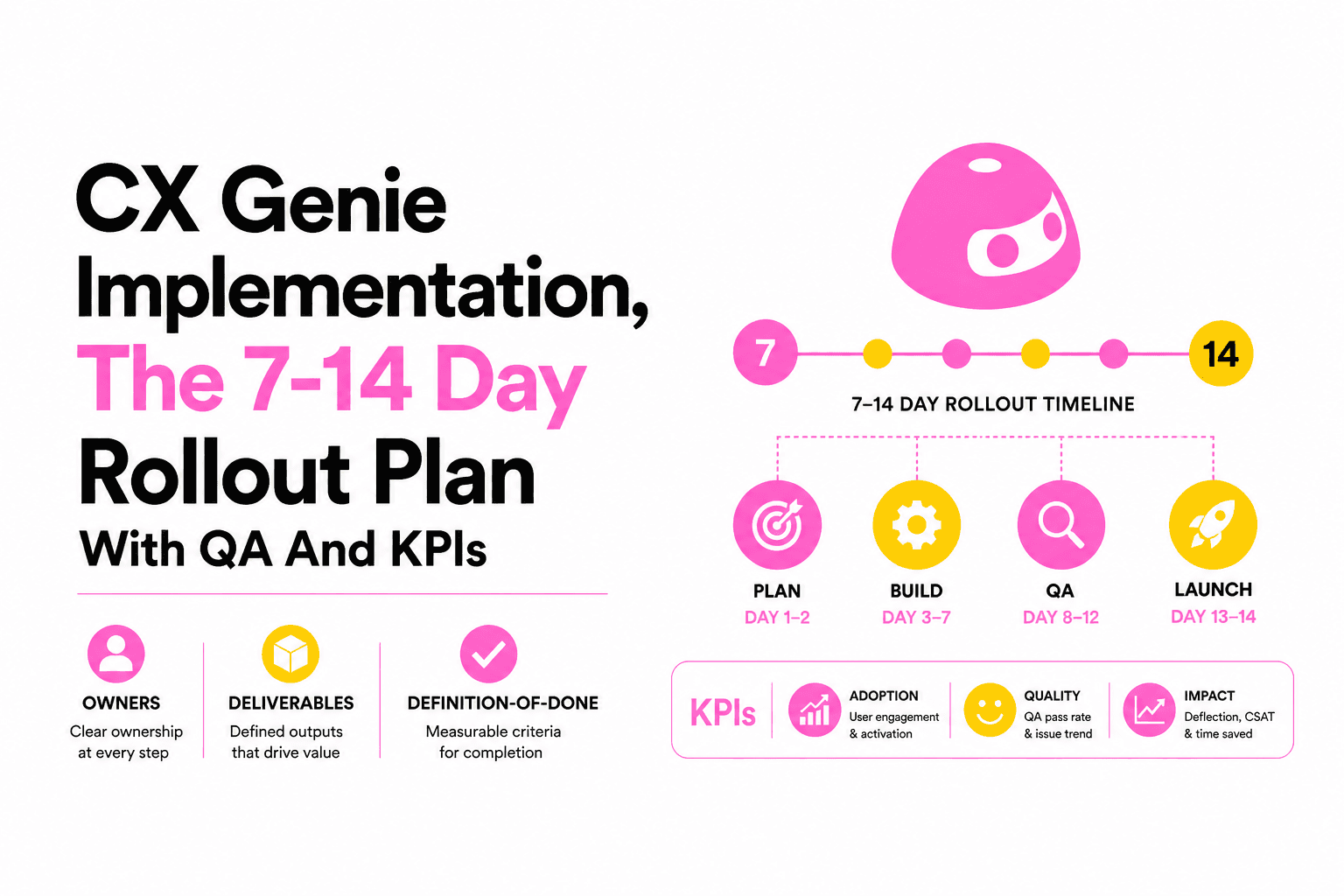
CX Genie Implementation, The 7-14 Day Rollout Plan With QA And KPIs
A practical cx genie implementation playbook: owners, knowledge onboarding, workflows, channel QA, and KPI gates to launch in 7-14 days.
Website Chatbot Integration: Launch a Bot in 10 Minutes
Website chatbot integration in under 10 minutes: capture leads, route support, and measure deflection. Try CX Genie self-serve, then scale to team.
Best AI Chatbot for B2B SaaS: Fast Setup, Measurable CX
Find the best ai chatbot for B2B SaaS with setup under 10 minutes, measurable deflection and lead capture. Try CX Genie self serve, then scale to teams.